






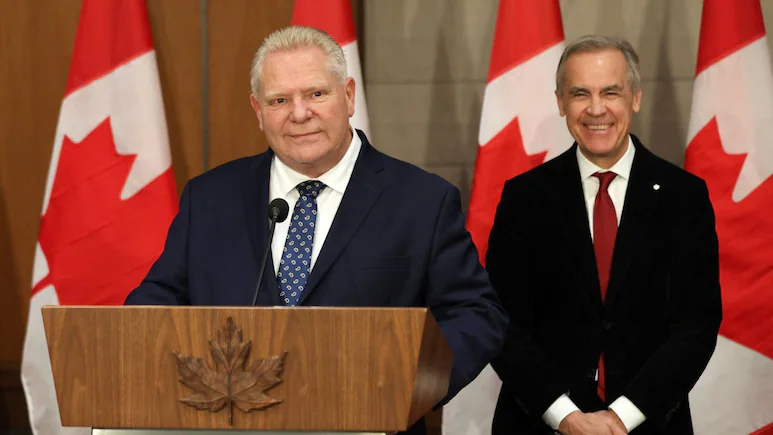
Toronto: Ontario Premier Doug Ford has launched a strong attack on US President Donald Trump’s trade policies, warning that Canada is prepared to withstand economic pressure rather than surrender to Washington’s demands. Ford also threatened to restrict the supply of electricity and critical minerals from Ontario to the United States if the trade dispute continues to escalate.
In an interview with The Associated Press, Ford said Trump had underestimated Canadians’ determination to defend the country’s economic interests, even if doing so required businesses and consumers to endure financial pain.
“He underestimates Canada. We’re all in,” Ford said, adding that Canadians were prepared for what he described as an “economic war”.
Ford Invokes Ronald Reagan
Ford sharply criticised Trump’s tariff strategy and said former US President Ronald Reagan, who was known for advocating free trade, would have opposed the current approach.
Ford said Trump had effectively declared an economic war against one of America’s closest allies and pointed to the portrait of Reagan that Trump keeps near his desk.
“He’d be throwing up on him from the picture if he knew what was going on,” Ford said, arguing that Reagan would have been deeply critical of Trump’s trade policies.
Ford had previously used excerpts from a 1987 Reagan speech warning about the dangers of tariffs and retaliatory trade measures in a television advertising campaign aimed at American audiences.
Trump Announces Further Tariffs
The confrontation intensified after Trump announced that 50 per cent tariffs on Canadian automobiles, auto parts and steel would begin next year.
Trump has repeatedly accused Canada of treating American businesses unfairly. In a social media post, he claimed that Canada had been “ripping off” the United States for years and criticised what he described as excessively high Canadian tariffs on American agricultural products.
The Trump administration has already imposed significant tariffs on Canadian goods, while Ottawa has announced retaliatory measures.
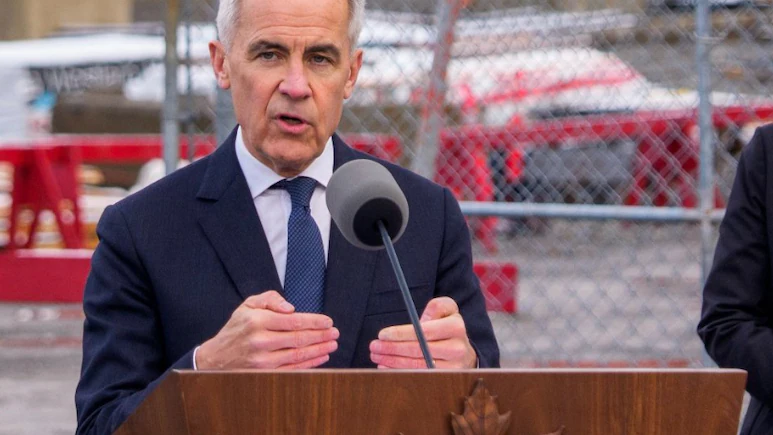
The latest escalation followed the collapse of trade negotiations between the two countries. Canadian Prime Minister Mark Carney said late last week that his government had rejected US demands that it considered excessive and harmful to Canada’s economic interests.
Ontario Threatens Electricity and Mineral Restrictions
Ford said Ontario could use its natural resources and electricity exports as leverage if Washington continues to target Canadian industries.
“Everything is on the table,” Ford said, warning that Ontario could restrict exports of electricity and critical minerals to the US.
He was particularly forceful about critical minerals, saying Ontario could halt shipments altogether.
“You won’t get a grain of sand out of Ontario,” Ford said.
Ontario supplies strategically important materials to the US, including high-grade nickel. The province also plays a role in uranium processing.
Critical minerals have become increasingly important to US national security because they are used in military aircraft, missiles, munitions, electronics and advanced manufacturing. Washington has been seeking more secure supplies as it attempts to reduce dependence on China, which dominates the mining or processing of several strategically important minerals.
Ford argued that the United States would face consequences if it attempted to undermine Canadian industries.
“What would they do without the high-grade nickel that we ship down to the US?” he asked.
Electricity Could Become a Bargaining Tool
Ford also raised the possibility of using Ontario’s electricity exports as a response to US tariffs.
Ontario supplies electricity to millions of homes and businesses in the United States, particularly in neighbouring states such as Michigan, Minnesota and New York.
“We power 1.5 million homes and businesses,” Ford said, adding that he was prepared to consider stronger measures if necessary.
Ontario has previously used electricity as leverage during the trade dispute. During an earlier phase of the confrontation, the province imposed a 25 per cent surcharge on electricity exported to Michigan, Minnesota and New York.
Trump responded at the time by threatening to increase tariffs on Canadian steel and aluminium. Both sides subsequently stepped back from further escalation.
Auto Industry at Centre of Dispute
Ontario’s automobile industry is particularly vulnerable to the latest tariff threats.
The province is the centre of Canada’s vehicle manufacturing sector, with major assembly plants operated by Ford, General Motors and Stellantis. The industry is closely integrated with manufacturing facilities in Michigan and other US states.
Automotive components frequently cross the Canada-US border several times during the manufacturing process. As a result, tariffs on vehicles and parts could significantly increase production costs and disrupt supply chains on both sides of the border.
Ford accused Trump of seeking more than simply better trade terms. He argued that Washington’s policies could weaken Canadian manufacturing and encourage companies to move production south of the border.
“He wants to bleed out every single sector and bring them down to the US,” Ford said.
He also accused the US president of attempting to turn Canada into a “vassal state”.
Disagreement Over Proposed Trade Deal
Ford also revealed that he had opposed a preliminary trade agreement that Prime Minister Carney had been considering before negotiations broke down.One issue involved the possible return of American liquor products to Ontario store shelves. Ford said he was unwilling to accept such a condition and had been prepared to publicly oppose the deal.
“I wasn’t going to put the booze back on the shelves,” he said, adding that he was prepared to hold a news conference to make his position clear.
Ford also said Washington had sought language that could have restricted Canada’s ability to negotiate trade agreements with other countries without US approval.
Carney has rejected such a demand, describing it as unacceptable and an issue involving Canadian sovereignty.
Ford questioned why the United States should have any authority over Canada’s independent trade policy.
Previous Clash Over Reagan Advertisement
Ford’s latest comments also revive an earlier dispute with Trump over the use of Ronald Reagan’s remarks on tariffs.
Last year, Ontario funded television advertisements in the United States featuring excerpts from Reagan’s 1987 address, in which the former president warned that tariffs could trigger retaliation and trade conflicts.
Trump accused Ontario of misrepresenting Reagan’s position and subsequently halted trade negotiations with Canada.
Ford later agreed to suspend the advertising campaign to allow discussions to resume.
Despite his increasingly strong rhetoric, however, Ford said Canada should not abandon negotiations altogether.
“I never believe in walking away from the table,” he said, indicating that Ottawa should continue seeking a negotiated solution.
Canada Signals Tougher Response
The dispute now places Canada and the United States in a delicate position. Both economies are deeply interconnected, particularly in the automotive, energy, manufacturing and agricultural sectors.
While Ford has warned that Ontario is prepared to use electricity and critical minerals as economic leverage, he has also maintained that negotiations remain the preferred path.
With Washington threatening additional tariffs and Canadian officials preparing retaliatory measures, businesses on both sides of the border face growing uncertainty.
For Ontario, the challenge will be to protect its major industries and jobs without causing further disruption to the highly integrated North American economy. For now, Ford’s message is clear: Canada is prepared to negotiate, but he says it will not simply accept US pressure without a response.