










Ottawa: Canada has announced retaliatory tariffs on around 700 US goods worth approximately $20 billion, escalating the trade confrontation between the two neighbouring countries. The new Canadian duties, ranging from 15 per cent to 50 per cent, are scheduled to take effect on September 8.
The move comes days after the United States imposed its own tariffs on Canadian products, with Washington’s latest measures taking effect on Saturday. Canadian officials said Ottawa’s response would broadly match the tariff levels imposed by the US and would affect a range of American products, including goods linked to the steel, dairy and electronics sectors.
Canada’s decision marks a significant escalation in the economic dispute between the two countries, whose economies are closely interconnected and heavily dependent on cross-border trade.
“This is an unprecedented challenge imposed on Canada. But Canada will meet the moment,” Canadian Finance Minister Francois-Philippe Champagne said while announcing the measures.
He also sought to project unity among Canadians, saying the government was standing together in response to the US tariffs.
Canada Rejects US Trade Terms
The latest measures follow the collapse of trade negotiations between Ottawa and Washington.
Canadian Prime Minister Mark Carney said last Friday that his government had decided to walk away from the negotiations because it considered the terms proposed by the Trump administration to be unfair and economically damaging to Canada.
Carney argued that the proposed agreement would have reduced the benefits Canada expected from a trade arrangement and placed major Canadian industries at risk.
“We cannot accept what they’ve offered, and we will not give what they’ve asked,” Carney said.
He accused Washington of targeting some of Canada’s most important industrial sectors, including automobiles, steel and aluminium.
“We learned during the negotiations that the Americans want to destroy our major industries, including autos, steel and aluminium,” Carney said, describing the proposed agreement as a “bad deal”. Carney also characterised the escalating dispute as a trade war, arguing that Canada had been forced to respond after being targeted by the United States.
“You’re at war when you get attacked. We got attacked,” he said.
Trump Warns Canada Against Defiance
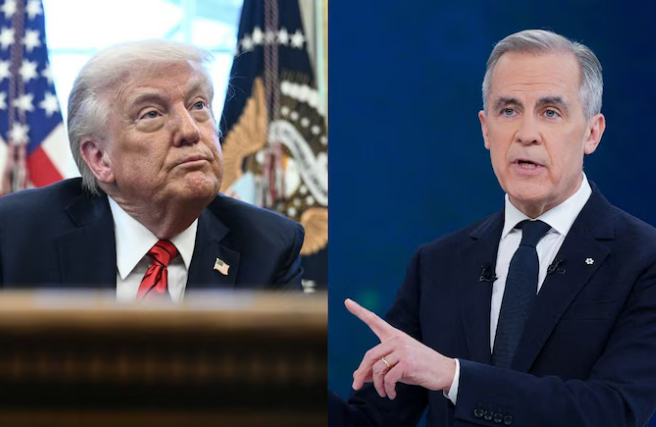
US President Donald Trump has taken an increasingly hard line against Canada, warning its government that it must change course or face further economic consequences.
Trump on Monday told Canadian leaders to “fall in line” and warned that the consequences could be significantly more severe than the tariffs already imposed.
The US president has repeatedly criticised Canada’s trade policies, particularly its tariffs on American agricultural products. He has argued that American farmers and businesses have faced unfair treatment in the Canadian market.
“Canada has been ripping off the United States of America for years,” Trump wrote on social media, while also criticising what he described as Canada’s “ridiculously high tariffs” on US farmers.
Trump has additionally threatened to impose further tariffs on Canada’s automotive industry, with the new measures potentially beginning next year. Industries Face Fresh Pressure
The latest round of tariffs could place additional pressure on businesses on both sides of the border.
Canadian officials said the retaliatory measures would cover a broad range of US products, with duties reaching as high as 50 per cent on some goods. The affected sectors include steel, dairy and electronics.
The tariffs are expected to increase costs for importers and businesses that depend on cross-border supply chains. Companies could potentially pass some of those additional costs on to consumers, while others may seek alternative suppliers or markets.
The dispute is particularly significant because Canada and the United States maintain one of the world’s largest trading relationships, with businesses in both countries deeply integrated through manufacturing and supply chains.
Trade Dispute Enters New Phase
The latest developments indicate that the disagreement has moved beyond negotiations and into a cycle of reciprocal trade measures.
Washington’s tariffs are already in effect, while Canada’s retaliatory duties are due to begin on September 8. Unless the two governments return to negotiations, businesses in both countries could face prolonged uncertainty over tariffs, supply costs and market access.
Carney’s government has maintained that Canada is prepared to defend its economic interests, while Trump has continued to demand changes in Canada’s trade policies.
The escalating dispute also raises concerns about its wider economic
impact. Higher tariffs could affect manufacturers, farmers, retailers and consumers, while prolonged uncertainty could discourage investment and disrupt established North American supply chains.
No Immediate Resolution in Sight
For now, neither side appears ready to back down. Canada has framed its response as a necessary defence of its economy, while the Trump administration has continued to press Ottawa to accept its trade demands.
With Canadian tariffs set to take effect in September and further US measures being threatened, the next few weeks could prove crucial for determining whether the two countries return to the negotiating table or allow the trade conflict to deepen.
The latest tariff announcements have therefore opened a new and potentially more difficult chapter in Canada-US economic relations, with businesses and consumers on both sides watching closely for signs of a negotiated settlement.