









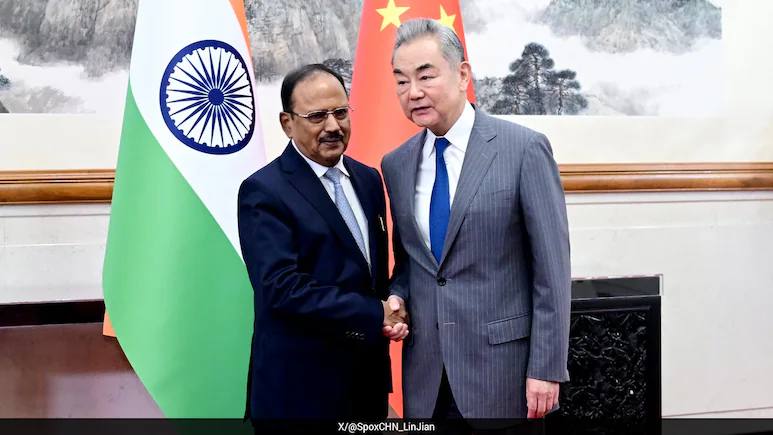
Beijing: India and China appear to be making cautious progress towards reviving dialogue on their long-running boundary dispute, with the two sides discussing ways to advance the delimitation process while maintaining peace and stability along the Line of Actual Control (LAC).
The development came as National Security Adviser Ajit Doval met Chinese Foreign Minister Wang Yi in Beijing on Tuesday for the 25th round of talks between the two countries’ Special Representatives on the boundary question.
The discussions focused on maintaining peace along the border, strengthening existing mechanisms for managing the boundary and exploring further steps towards delimiting sections of the disputed frontier.
Although neither side specified which particular stretches of the LAC could be taken up for delimitation, the renewed emphasis on the issue is being viewed as a significant development in the gradual improvement in India-China relations following years of military and diplomatic tensions.
Focus on ‘Early Harvest’ Approach
A key element of the discussions is the possibility of adopting an “early harvest” approach to the boundary dispute.
Instead of attempting to resolve the entire border question in one comprehensive agreement, the approach seeks to identify relatively manageable sections where progress could be achieved first.
During the previous round of Special Representatives’ talks, India and China had agreed to establish a working group to explore such an approach. The latest meeting indicates that the idea remains part of the ongoing efforts to make incremental progress on the boundary issue.
The India-China boundary dispute has remained unresolved for decades, with the two countries holding numerous rounds of negotiations without reaching a final settlement. Against this backdrop, even limited progress on individual sections could help build confidence and create conditions for further negotiations.
Doval: Relations ‘Steadily Returning to Normalcy’
The latest talks come at a significant time for bilateral relations, which deteriorated sharply after the 2020 military confrontation in eastern Ladakh.
Doval said India-China relations were “steadily returning to normalcy” and credited Prime Minister Narendra Modi and Chinese President Xi Jinping with providing “clear and positive direction” to the relationship.
According to Doval, a major focus of Tuesday’s discussions was ensuring peace and tranquillity along the border and consolidating the stability achieved so far.
For New Delhi, maintaining peace along the LAC remains a key prerequisite for rebuilding broader ties with Beijing.
China Calls for Continued Dialogue
Wang Yi also stressed the importance of preventing the boundary dispute from disrupting the overall India-China relationship.
He said the two countries should learn from the past and avoid allowing differences over the border to derail broader bilateral engagement.
Wang called for continued dialogue and consultation, urging both sides to ensure that the relationship does not stagnate, move backwards or lose its direction.
He also emphasised the importance of strengthening communication and mutual understanding while addressing differences through established diplomatic mechanisms.
Extensive Discussions in Beijing
The Special Representatives held extensive discussions during Tuesday’s meeting.
The talks began with a smaller meeting that lasted more than 90 minutes before moving into a broader delegation-level session that continued into the evening.
Doval also met Chinese Vice- President Han Zheng during his visit to Beijing.
The meetings are part of a wider revival of high-level engagement between India and China following the deterioration in relations after the 2020 border crisis.
Over the past year, several institutional mechanisms that had remained inactive have resumed meetings, while both countries have taken steps aimed at maintaining stability along the LAC and gradually rebuilding bilateral engagement.
Existing Framework for Boundary Settlement
During the latest discussions, both sides reviewed progress made on commitments from the previous round, including issues related to delimitation, border management, institutional exchanges and cross-border cooperation.
India and China also reaffirmed the 2005 Political Guiding Principles, which continue to serve as an important framework for negotiations on the boundary question.
The two sides agreed to continue using the Special Representatives’ mechanism to work towards what they described as a “fair, reasonable and mutually acceptable package solution” to the boundary issue.
However, officials on both sides have not indicated that a comprehensive settlement is imminent.
Incremental Progress Seen as Practical Path
The renewed focus on delimitation is significant because the India-China boundary question has remained unresolved despite more than two decades of negotiations.
A complete settlement is considered difficult in the near term because of the complexity of competing territorial claims and the strategic sensitivity of the frontier.
The “early harvest” model could therefore offer a more practical route to progress by focusing initially on selected areas where an agreement may be easier to achieve.
Such incremental progress could also help build trust between the two countries and create a more favourable environment for tackling the larger boundary dispute in the future.
Ground Situation Remains Crucial
Despite the diplomatic thaw, developments on the ground will remain critical to the success of the process.
Military disengagement, continued
calm and effective management of the LAC are likely to remain the foundation for further political and diplomatic progress.
For India, the priority continues to be maintaining peace and tranquillity along the border while using the improving political atmosphere to push forward negotiations on the boundary question.
Xi Jinping’s Expected India Visit Adds Significance
The timing of the Beijing talks is also notable as Chinese President Xi Jinping is expected to visit New Delhi next month for the BRICS Summit on September 12. If the visit takes place, it would be his first trip to India in seven years and could provide another opportunity for the two sides to deepen their engagement.
Wang also highlighted the broader importance of India-China relations, saying that ties between the two countries have implications beyond their bilateral relationship and for the wider global order.
He called on India and China to become “good-neighbourly friends” and partners, using the phrase “Dragon-Elephant Dance” to describe the possibility of cooperation between the world’s two major Asian powers despite their differences.
A Cautious Step Towards Normalisation
Tuesday’s talks do not signal an immediate resolution of the border dispute, but they do point to a gradual effort by New Delhi and Beijing to rebuild communication and manage their differences.
The renewed attention to delimitation, continued diplomatic engagement and the resumption of institutional mechanisms suggest that both sides are seeking practical ways to prevent the boundary dispute from overwhelming the broader relationship.
With Xi’s expected visit to India approaching, the progress made during the latest round of talks could prove important in shaping the next phase of India-China relations. For New Delhi, the objective remains to preserve peace along the LAC while pursuing incremental and sustainable progress towards a long-term boundary settlement.
The coming months will show whether the latest diplomatic momentum can translate into concrete progress on the ground and in the broader boundary negotiations.