











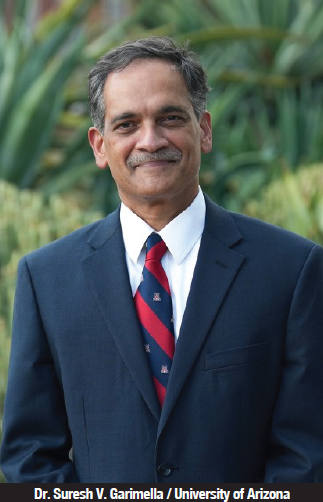
From growing up in a first-generation family to studying at IIT Madras and the University of California, Berkeley, and eventually leading a major American research university, Suresh Garimella’s journey reflects academic excellence, research leadership and a sustained connection with India.
In an exclusive conversation with India Abroad, Garimella discusses the changing landscape of higher education in India, the need to broaden access to quality education, the importance of research and innovation, student well-being, and the opportunities for deeper India-U.S. academic partnerships.
1. From Personal Journey to Systemic Lessons
Your journey from a non-graduate family to IIT Madras, Berkeley and eventually the presidency of a leading global university is remarkable. Looking back, what proved decisive — family, individual determination or the Indian education system? And what does your experience tell us about what Indian higher education does well and where it falls short for the millions who do not make it to an IIT?
I have been fortunate throughout my life to benefit from all three. My family instilled in me the belief that education can transform lives. My teachers challenged and inspired me from first grade through high school at Kendriya Vidyalaya-Malkapuram and beyond. The opportunities provided by institutions such as IIT Madras opened doors that fundamentally changed the course of my life.
My experience also reinforces a simple truth: talent is distributed far more widely than opportunity.
One of India’s greatest strengths is the deep respect its people have for learning and academic achievement. India produces exceptional students, faculty members, researchers and entrepreneurs who can compete successfully anywhere in the world.
The challenge now is to ensure that excellence is not restricted to a small group of institutions. Every capable student should have access to a high-quality education that prepares them for a meaningful career and a purposeful life.
That belief has motivated my work with the Confederation of Indian Private Universities (CIPU). We are seeking to share best practices, strengthen institutional leadership and build a culture of excellence across the higher education system rather than allowing it to remain concentrated in a handful of universities.
2. The Structural Fault Lines in Indian Higher Education
India has more than 1,000 universities and over 42,000 colleges, yet concerns about
employability, research output and global rankings remain. Where are the deepest structural weaknesses — governance, funding, curriculum or the gap between the vision of the National Education Policy 2020 and its implementation? What needs to change most urgently?
India has made remarkable progress in expanding access to higher education, and the National Education Policy provides an ambitious roadmap. The next major challenge is implementation.
Several priorities must move forward simultaneously. Universities need governance systems that promote both agility and accountability. They must invest in faculty development and leadership at every level. Most importantly, student success — rather than simply enrollment — must become a central institutional priority.
Research and innovation, particularly work addressing India’s pressing social and economic challenges, should be treated as core university missions alongside teaching.
One lesson we have emphasized through CIPU is that institutional transformation can come from university leaders learning from one another and focusing on measurable outcomes. That philosophy inspired an early Visioning Workshop I convened in Washington, D.C., bringing together education leaders from India and the United States. It was followed by planning workshops in Pune that ultimately contributed to the creation of CIPU.
3. Reconciling Access and Excellence
CIPU promotes quality and relevance through leading private universities, but private education can be expensive. First-generation learners, rural students and young women from smaller towns may remain excluded. How can CIPU reconcile excellence with access? Should private universities adopt a
sector-wide financial-aid framework, or can technology become the great equalizer?
A truly excellent university should expand opportunity while maintaining high expectations. Land-grant universities in the United States have demonstrated how that can be achieved.
Technology has an important role in widening access to high-quality instruction and lifelong learning, but it cannot be the entire solution. Institutions also need strong student-support systems, industry partnerships, philanthropy, flexible educational pathways and a sustained commitment to student success.
With the growing wealth in Indian society, I hope there will be a greater willingness to support precisely the kind of access you describe. Industry, too, can and should do more to train the workforce that represents its own future.
Ultimately, excellence should be measured by how effectively universities help students graduate prepared to contribute to their communities and economies — to improve lives and livelihoods. That is also what I believe can help India move toward the vision of Viksit Bharat.
4. Beyond Grades: Educating the Whole Person
Indian higher education has built a strong culture around academic and extracurricular achievement, but qualities such as empathy, civic responsibility, ethical reasoning and emotional literacy often receive less attention. Why has education been reluctant to engage with this dimension? Can universities produce humane citizens without doing so?
Universities have a responsibility to educate the whole person, not merely prepare students for their first job.
Many thinkers have emphasized the importance of educating the whole student. One can draw inspiration from John Dewey, the celebrated educational reformer and a graduate of the University of Vermont, where I had the honor of serving as president, as well as from modern figures such as Steve Jobs.
Academic excellence remains essential and will require continued attention in Indian higher education. But students should also graduate with the ability to work across disciplines and cultures, communicate effectively, solve complex problems, lead with integrity and contribute positively to society.
Universities have a unique opportunity to expose students to diverse perspectives through research, community engagement and experiential learning. Internships with companies and nonprofits, service-learning and, where possible, study-abroad programmes can help develop empathy and ethical reasoning
alongside technical expertise.
5. Gen Z and the Leadership Dialogue Gap
Young people today are globally connected and deeply aware of issues such as climate change, artificial intelligence and social justice. Yet many feel universities are preparing them for a world that no longer exists. How should institutions address the growing gap between student agency and institutional authority while preserving campuses as spaces for free inquiry?
Students today are entering a rapidly changing world shaped by artificial intelligence, geopolitical shifts, climate challenges and technological disruption. Universities must evolve just as quickly.
Students deserve institutions that listen carefully, encourage thoughtful dialogue and prepare them for uncertainty rather than for a single career path. At the same time, universities have an obligation to preserve academic rigor, intellectual curiosity and evidence-based inquiry.
The strongest universities create environments where differing viewpoints can be discussed respectfully while remaining focused on their educational mission.
One of the most fulfilling activities of my career was teaching a course on civil discourse at the University of Vermont. When students are given the freedom to explore difficult questions, consult diverse sources and discuss ideas among themselves in an environment free from judgment, the depth and thoughtfulness of the resulting dialogue can be remarkable.
6. Student Well-Being as an Academic Priority
Mental health challenges among young people on Indian campuses are increasingly visible, with anxiety, performance pressure and isolation affecting students. Yet well-being is often treated as a secondary concern. What can Indian university leaders learn from the University of Arizona’s approach?
Student success depends on much more than classroom instruction. Students learn best when they feel supported and are able to thrive both academically and personally.
At the University of Arizona, we have made the success of every student our North Star. That includes academic advising, career preparation, research opportunities and study abroad, as well as investment in student health and well-being.
Beginning this fiscal year, we made counseling services available to students at no cost, removing a financial barrier to care and making it easier for students to seek help when they need it.
Supporting well-being is an essential part of academic excellence. Students
who feel connected and healthy are better positioned to learn, overcome challenges and reach their full potential. Universities should therefore view these services as investments in student success.
I remember the highly competitive atmosphere at IIT Madras even four decades ago. To help fellow students cope with the pressures, some of us started a peer-counseling service. I do not know how many universities and colleges in India currently prioritize such efforts, but they can be profoundly meaningful.
7. Turning Universities into Engines of Research and Innovation
India’s research and development spending remains far below that of the United States. But the challenge is not simply about funding; institutional culture also matters. What needs to change for Indian universities to become genuine centers of knowledge creation and innovation rather than degree-delivery institutions?
Research excellence begins with culture.
Funding is certainly important, but universities must also create environments that reward curiosity, collaboration and long-term thinking. Faculty members need opportunities to pursue discovery, along with the infrastructure and institutional support necessary to succeed.
I recall a conversation with an overseas university where leaders were discussing ambitious commercialization goals but lacked even the institutional structure required to support patent filing or faculty entrepreneurship.
University reward systems also need to evolve. They should recognize meaningful knowledge creation, innovation and real-world impact rather than rely excessively on mechanical metrics. This is a challenge faced by universities around the world, and I am afraid most institutions have not yet fully solved it.
Students should also be introduced to research early in their education. Beyond government funding, universities need to develop meaningful and mutually beneficial partnerships with industry and philanthropy. Such relationships can expand the funding base while increasing the societal impact of research.
At the University of Arizona, we have chosen to focus our research enterprise on areas where we believe we can make the greatest difference, including space science, artificial intelligence in healthcare, mining and critical minerals, fusion energy and arid-region agriculture.
Every university should identify its distinctive strengths and build its research strategy around them.
8. Building a Meaningful India-U.S. Academic Bridge
You have spent decades in American higher education while maintaining strong connections with India through CIPU. Beyond delegation visits and memorandums of understanding, what does a genuinely transformative India-U.S. academic partnership look like? What should Indian universities learn from the American system — and what should they avoid?
The strongest international partnerships are built around shared priorities.
As a proud product of Indian education, it has been my honor and privilege to remain engaged with Indian institutions for several decades, most recently through the creation of CIPU.When institutions collaborate on governance, systems improvement, research, faculty development, student success and workforce preparation, everyone benefits.
There is first a role for individual partnerships, both at the faculty-to-faculty and institutional levels. Without a core group of faculty members driving a partnership forward, sustained success is unlikely.
But partnerships can also move beyond individual institutions. Connecting networks of universities with shared goals creates opportunities to exchange ideas and successful practices, strengthen leadership, improve research and accelerate innovation on a larger scale.
Such partnerships must be reciprocal. India has much to teach American universities, just as American institutions have experiences that may benefit India. The objective should be to learn from one another while building on each country’s own strengths, culture and priorities.
9. India’s Higher Education Ambition
India wants to become a global education hub within the next decade, attract international students, build world-class universities and reduce brain drain. Is that realistic? What are the essential conditions, and what is the reform that receives too little attention?
I believe in setting ambitious goals and inspiring people to achieve them.
I am not an expert in every aspect of India’s education system. K-12 education, for example, is critical because universities can only build on the foundation students receive in school. Universal access to high-quality schools should therefore be a non-negotiable goal.
Beyond that, India has extraordinary talent, a growing economy and a broad commitment to education. If universities continue to strengthen institutional quality while promoting research, international collaboration and student success, India can become one of the world’s leading higher education destinations.
Achieving that will require thoughtful and stable policymaking, regulatory and governance reform, and sustained investment in people, institutional leadership and research infrastructure.
It will also require greater collaboration among universities, stronger links with industry and government, and an unwavering focus on student outcomes and societal impact.
Universities should continually ask themselves what value they are creating for students and for society.
10. A Message to the Next Generation
You began as the child of a first-generation family, found your path through education and now lead a global research university while helping shape India’s private university ecosystem. What would you say to a 17-year-old in a small Indian town who is ambitious but feels that quality education is beyond reach? What needs to change to make that door truly accessible?
Never underestimate what education can make possible.
Every step of my journey was made possible because my parents, teachers, mentors and educational institutions believed in my potential.
Your background does not determine your future. Curiosity, persistence and a willingness to keep learning can open doors throughout your life.
If you can, find a mentor who can guide you — a teacher, sibling, parent, neighbour or anyone who believes in your potential. We could all use a helping hand at important moments in our lives, so do not hesitate to ask for one.
Above all, do not give up hope.
Our responsibility as educators — and as governments — is to ensure that the doors of opportunity remain open to every talented student, regardless of where they begin.
For Garimella, the future of higher education ultimately comes down to expanding opportunity without compromising excellence. His own journey — from a first-generation family in India to the leadership of a major American research university — serves as a reminder of what education can make possible when talent is given the right opportunities. As India seeks to strengthen its universities and emerge as a global education hub, he believes the focus must remain firmly on students, research, innovation and societal impact. The goal, he suggests, should not simply be to produce more graduates, but to build an education system capable of unlocking the potential of every talented young Indian. His message is ultimately one of opportunity, inclusion and hope. India’s next generation, he believes, has the talent to shape the future. The task before institutions is to ensure that no promising student is left without a path to that future. For a country as young and ambitious as India, investing in education is ultimately an investment in its own future. The challenge is to turn that ambition into opportunity and opportunity into lasting impact. That, in many ways, is the real promise of India’s higher education transformation.