








From Procurement to Strategic Capabilities, Ties Take a Deeper Turn
New Delhi and Washington are building a more comprehensive defence partnership, with a focus on technology, co-production, and long-term air power capabilities.
Special Correspondent | New Delhi
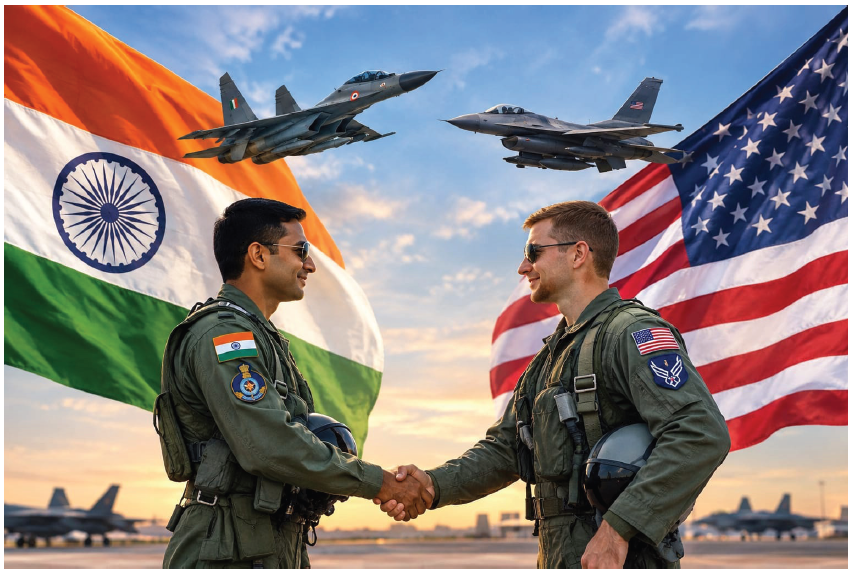
The defence relationship between India and the United States is entering a new phase, with air power emerging as a key pillar of their strategic partnership. What began with military exercises, individual platform acquisitions and growing defence trade is now evolving into deeper cooperation focused on technology, aerospace manufacturing, interoperability and the development of long-term capabilities to strengthen India’s air power.
A Shift in the Character of Air Warfare
Modern air power is no longer built around individual platforms alone. It relies on networks of manned and unmanned aircraft, advanced sensors, electronic warfare systems, precision weapons, secure communications and real-time intelligence. The ability to integrate these elements into a unified combat architecture is becoming increasingly decisive. The India–US partnership is gradually reflecting this shift.
F414 Engine: A Step Toward Self-Reliance
A major milestone has been the progress on the General Electric F414 fighter engine, intended to power India’s Tejas Mk2, being developed by Hindustan Aeronautics Limited (HAL). In April 2026, the two countries reached an agreement under which GE and HAL would work towards co-producing the engine in India. The proposed arrangement envisages the transfer of a substantial share of manufacturing technology and intellectual property.
While the technical aspects have been agreed upon, commercial negotiations remain ongoing, with a final contract expected later in the year. The programme is significant because access to advanced aero-engine technology has long been one of India’s most difficult defence-industrial challenges.
India has demonstrated its ability to design sophisticated aircraft while continuing to face difficulties in producing high-performance fighter engines at scale. The F414 programme could provide domestic industry with valuable experience in high-precision manufacturing, specialised materials, engine assembly and aerospace supply chains. It may also establish a stronger foundation for future indigenous propulsion projects.
For India, access to advanced aerospace technology has implications extending well beyond a single aircraft programme. Successful implementation could help build industrial expertise, strengthen domestic suppliers and support the country’s long-term ambition to achieve greater technological independence.
Drones Add a New Dimension
The partnership has also expanded into unmanned systems. India is set to acquire 31 MQ-9B remotely piloted aircraft from the United States in a deal worth around $4 billion. The planned package includes 15 SeaGuardian aircraft for the Indian Navy and eight aircraft each for the Indian Army and Indian Air Force.
A March 2026 report by the US Congressional Research Service identifies the programme as an important element of expanding US–India defence trade. The MQ-9B acquisition illustrates why the relationship cannot be viewed solely through the lens of fighter aircraft procurement.
Long-endurance unmanned platforms can provide persistent intelligence, surveillance and reconnaissance over vast geographical areas. These capabilities are particularly relevant to India’s security requirements across the Indian Ocean, the Himalayan frontier and its extensive maritime approaches. They can improve situational awareness, support maritime monitoring and help commanders make better-informed operational decisions.
A Partnership for Diverse Challenges
India’s security environment demands an air force capable of operating across multiple theatres. The Himalayan frontier presents demanding high-altitude requirements, while the western theatre calls for readiness and the ability to respond rapidly to changing circumstances. The Indian Ocean, meanwhile, requires long-range surveillance, maritime strike capabilities and effective air defence.
China’s expanding air power adds another dimension to India’s strategic planning. These challenges make it increasingly important for India to develop an integrated air-power structure that combines aircraft, unmanned platforms, sensors, intelligence networks and precision capabilities.
Beyond Buyer and Seller
The India–US relationship is no longer limited to conventional procurement. Technology cooperation, co-production and shared industrial innovation are becoming important elements of India’s military capability development. By combining American technological strengths with Indian industrial capacity, the partnership has the potential to create a stronger, more self-reliant and future-ready aerospace ecosystem.
The broader objective is to move beyond the acquisition of individual platforms towards building capabilities that can serve India’s security needs over the long term.
Looking Ahead
As both nations deepen their defence cooperation, the central challenge will be to turn agreements into operational capabilities and sustainable industrial outcomes. Technology transfer, manufacturing execution, supply-chain development and effective integration will be critical to determining the partnership’s long-term value.
A successful transition could help India strengthen its domestic aerospace industry while improving interoperability with the United States. In an increasingly complex Indo-Pacific security environment, the partnership may play a significant role in supporting a more capable, technologically advanced and resilient Indian air-power framework.
The expanding defence ties between India and the United States are not limited to new platforms and acquisitions. They are increasingly focused on building a framework for long-term cooperation that spans technology, industrial collaboration, logistics, and regional security. The partnership has evolved significantly over the past decade, with both sides recognising that the future of defence cooperation lies in shared innovation, interoperability and the ability to develop and sustain advanced military systems.
A key driver of this progression has been the growing interaction between the Indian Air Force and the US Air Force. In April 2026, Air Chief Marshal A.P. Singh flew in the F-15EX Eagle II at Nellis Air Force Base in Nevada, gaining first-hand exposure to an advanced combat platform and the operational concepts behind its use. This interaction reflects the deepening institutional ties between the two air forces and the willingness of both sides to learn from each other’s operational experience.
The formal foundation for the partnership was laid in 2016, when the United States designated India a Major Defence Partner. Since then, defence trade has become a major pillar of the relationship. The two countries signed the Logistics Exchange Memorandum of Agreement (LEMOA) in 2016 for reciprocal base access, followed by the Communications Compatibility and Security Agreement (COMCASA) in 2018 for secure communications and the Basic Exchange and Cooperation Agreement (BECA) in 2020 for geospatial intelligence and mapping support. In 2023, Washington also launched the India-US Defence Acceleration Ecosystem (INDUS-X), a new initiative to promote technology collaboration, co-development and defence industrial growth between the two nations.
Defence trade has been central to the security partnership since 2008, with regular military exercises across the three services now a routine feature of the bilateral relationship. India already operates several advanced US platforms, including Apache helicopters, P-8I maritime aircraft and C-17 transporters, which play a vital role in strengthening its operational capabilities across land, sea and air.
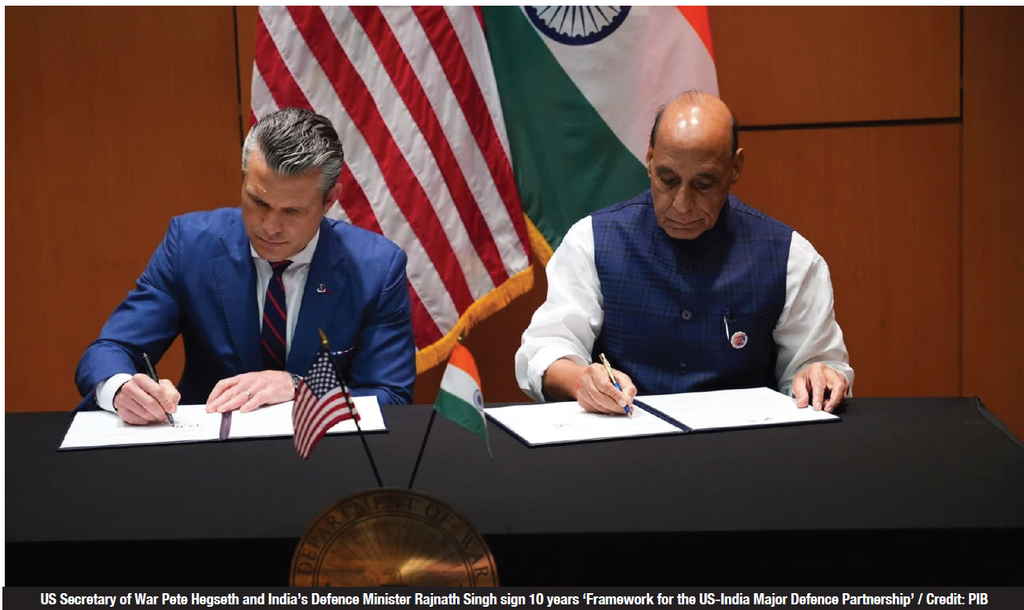
The current ten-year framework seeks to take this cooperation to a deeper level. It places interoperability, defence technology and industrial collaboration at the centre of the partnership, with a focus on building an integrated air-power ecosystem. The goal is not just to acquire platforms, but to ensure they work together on research, development, production and sustainment so that India can build its own capacity and reduce long-term dependence on foreign suppliers.
The F414 engine programme for the Tejas Mk2 is a critical test of this approach. The real value of technology transfer will be measured by how well Indian industry can absorb the knowledge, develop skilled manpower, strengthen supply chains and apply the experience to future programmes, including the Advanced Medium Combat Aircraft (AMCA). The aim should be to use the F414 experience as a stepping stone towards greater indigenous propulsion capability and a stronger aerospace manufacturing base.
However, the relationship also comes with risks. Increased reliance on American systems can create vulnerabilities in supply chains, software, maintenance, upgrades and export controls. India therefore needs a calibrated approach—one that expands strategic options rather than creating a new form of technological dependence. American technology should complement indigenous development, while India continues to maintain defence relationships with France, Russia, Israel and other partners that meet specific national requirements.
The true opportunity lies in building an air-power ecosystem capable of absorbing technology from multiple sources and integrating it through increasingly indigenous systems. This will not only strengthen India’s defence preparedness but also contribute to the development of next-generation platforms, including the AMCA. For India, the significance of the F414 programme extends beyond the Tejas Mk2—it is a test of the country’s ability to turn access to foreign technology into domestic capability and long-term self-reliance.
The India-US air-power partnership has the potential to become a model for strategic technology cooperation. Its success will depend on whether it moves beyond simple procurement to focus on capability creation, from technology access to technology absorption, and from individual platforms to an integrated air-power ecosystem. India must convert the advantages of this collaboration into stronger indigenous capabilities, ensuring that the partnership contributes to a more secure, self-reliant and future-ready Indian defence ecosystem.
The broader context of this partnership also reflects a changing global security environment. With increasing strategic competition, both India and the United States see the Indo-Pacific as a critical region for stability and growth. Stronger defence cooperation, particularly in air power, helps both nations deter potential challenges, respond to emerging threats and support a rules-based international order.
At the same time, India’s approach remains clear—deeper cooperation with the US should enhance strategic autonomy, not limit it. The partnership must be structured in a way that strengthens India’s ability to make independent decisions, build domestic capability and maintain flexibility in its foreign and defence policies.
The coming years will be crucial in determining how much of this cooperation translates into real capability on the ground. The focus must be on technology absorption, industrial growth, skilled manpower and an integrated air-power ecosystem that can support India’s long-term strategic goals. If managed well, the India-US defence partnership has the potential to not only strengthen current capabilities but also lay the foundation for a more advanced, resilient and self-reliant Indian Air Force—and a stronger national defence ecosystem for the future.
Photograph caption: US Secretary of War Pete Hegseth and India’s Defence Minister Rajnath Singh sign a ten-year framework for the US-India Major Defence Partnership. (Credit: PIB)
Pull quote: “The real value of the India-US defence partnership will lie in how effectively it helps India build indigenous capability, strengthen its defence industrial base and secure long-term self-reliance.”
Key Agreements and Milestones
- 2016: India designated a Major Defence Partner by the United States.
- 2016: LEMOA — Reciprocal logistics and base access.
- 2018: COMCASA — Secure military communications.
- 2020: BECA — Geospatial intelligence and mapping cooperation.
- 2023: INDUS-X — Defence technology and industrial collaboration.