













Bizarre ball sails over batter and wicketkeeper into the stands, sparking questions about boundary rules in the Canada Super60 semi-final
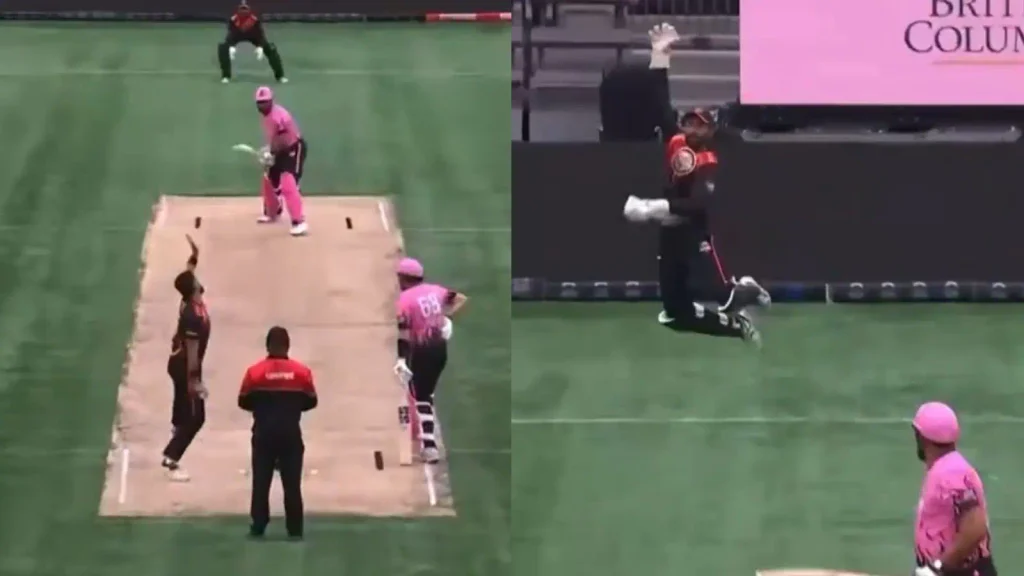
VANCOUVER, CANADA — The Canada Super60 tournament’s semi-final between Toronto Sixers and Mississauga Masters produced one of the most extraordinary moments in recent cricket history when USA pacer Ali Khan delivered a ball that quite literally appeared to “defy the laws of cricket.” A bouncer flew over the batter and wicketkeeper before landing in the stands, leaving players, commentators and spectators astonished.
The incident took place during the ninth over of Mississauga Masters’ innings at BC Place in Vancouver. Khan, bowling to Toronto Sixers captain Kieron Pollard, unleashed a high, full bouncer that cleared both the batter and the wicketkeeper, sailed beyond the boundary rope and landed directly in the crowd.
The commentators were initially left speechless, with some reacting by calling it a wide and a six. However, the on-field umpire signalled only a wide, awarding five runs to Toronto Sixers. The unusual decision prompted questions about whether a delivery that crosses the boundary without touching the bat can be counted as a six.
What the Laws of Cricket Say
According to the Marylebone Cricket Club (MCC), which maintains the Laws of Cricket, a boundary six can be awarded only when the ball has been struck by the bat and meets the conditions specified in the relevant law.
MCC Law 19.7.1 — Boundary 6
A boundary six is scored if and only if the ball has been struck by the bat and is first grounded beyond the boundary without having been in contact with the ground within the field of play. This applies even if the ball has previously touched a fielder.
MCC Law 19.7.2 — Boundary 4
A boundary four is scored when a ball is grounded beyond the boundary, whether struck by the bat or not, if it was first grounded within the boundary or has not been struck by the bat.
In simple terms, a wide delivery that the batter never touches can be awarded four boundary runs if it crosses the boundary on the full. The standard one-run wide penalty is added separately under Law 22.6. Therefore, the total is five wides rather than seven runs.
The ruling highlights an important distinction in cricket’s boundary-scoring rules: the ball crossing the rope does not automatically mean six runs. Whether the batter has struck the ball with the bat is a crucial factor in determining the appropriate boundary allowance.
A Bizarre Moment in an Otherwise Thrilling Contest
Despite the unusual delivery becoming the talking point of the match, the semi-final delivered plenty of entertainment with the bat.
Toronto Sixers posted an imposing 130/4 in their allotted 10 overs. Kieron Pollard led the charge with an explosive 40 off just 16 deliveries, helping Toronto establish a challenging total in the fast-paced format.
In response, Mississauga Masters fought hard, with Alex Lees producing a blistering 39 off only 11 balls. His aggressive innings gave the chase considerable momentum, but Mississauga ultimately fell nine runs short of the target.
Toronto Sixers’ victory secured their place in the tournament final. In the other semi-final, Vancouver Anchors defeated Brampton Blitz by six wickets, setting up a title showdown between Vancouver and Toronto.
A Delivery That Captured Everyone’s Attention
Ali Khan’s extraordinary bouncer quickly became the defining talking point of the semi-final. The ball’s unusual trajectory, combined with the unexpected boundary-scoring decision, left fans debating the incident and revisiting the relevant laws of the game.
While Toronto’s victory was the main sporting outcome, the delivery offered a reminder that cricket can still produce moments that challenge expectations, even for experienced players and commentators.
With Toronto Sixers advancing to the final and Vancouver Anchors securing the other spot, attention now turns to the championship clash. However, Khan’s bizarre delivery is likely to remain one of the most memorable moments of the Canada Super60 tournament.