







New Delhi: India on Friday rejected remarks on Jammu and Kashmir made by Norwegian Foreign Minister Espen Barth Eide, asserting that the international community’s attention should instead be directed towards what New Delhi describes as Pakistan’s continued use of Pakistan-occupied Kashmir (PoK) for cross-border terrorism.
The Indian government’s response came a day after Eide held talks with Pakistan’s Foreign Minister Ishaq Dar in Islamabad. Following the meeting, the Norwegian foreign minister said the two sides had discussed a range of regional issues, including Jammu and Kashmir and the situation in Afghanistan.
Dar, meanwhile, said he had briefed Eide on what Pakistan described as the “long-standing unresolved” Kashmir dispute.
India, however, strongly rejected any suggestion that Jammu and Kashmir remains an unresolved territorial issue between the two countries.
India Reaffirms Position on Jammu, Kashmir and Ladakh
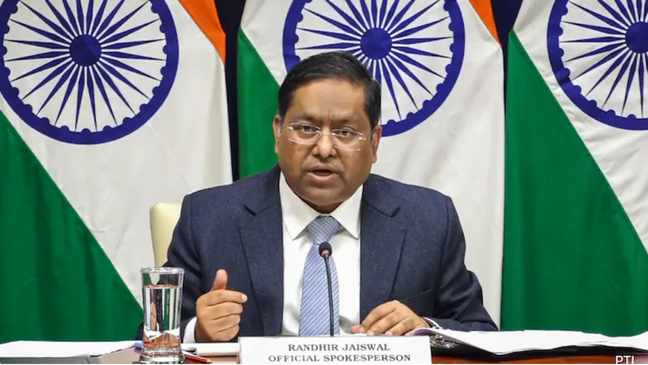
Responding to questions about the Norwegian foreign minister’s remarks, External Affairs Ministry spokesperson Randhir Jaiswal reiterated New Delhi’s long-standing position that Jammu and Kashmir and Ladakh are integral parts of India.
“Let me say that the whole of Jammu, Kashmir and Ladakh are an integral and inalienable part of India,” Jaiswal said during the MEA’s bi-weekly media briefing.
He also shifted the focus to Pakistan-occupied Kashmir, saying that the international community should be concerned about developments in the region and its alleged use for cross-border terrorism.
“The issue that should concern the international community is the atrocities currently being perpetrated in the illegal Pakistan-occupied Kashmir and the use of Pakistan-occupied Kashmir for cross-border terrorism,” Jaiswal said.
New Delhi has consistently maintained that Pakistan must stop supporting terrorism and dismantle infrastructure used to facilitate cross-border attacks before meaningful progress can be made on broader bilateral issues.
Norway-Pakistan Talks Trigger India’s Response
Eide’s remarks followed his meeting with Ishaq Dar in Islamabad, where regional security and political developments were discussed.
The Norwegian foreign minister said Jammu and Kashmir was among the subjects raised during the talks, along with the situation in Afghanistan and other regional matters.
Pakistan has repeatedly sought international attention on the Kashmir issue and describes it as an unresolved dispute. India, however, maintains that Jammu and Kashmir is an integral part of the country and that issues between India and Pakistan should be addressed bilaterally and in an environment free from terrorism and violence.
New Delhi has also objected to attempts to internationalise the Kashmir issue, maintaining that third-party involvement is neither necessary nor acceptable.
The latest exchange comes amid continued tensions between India and Pakistan, particularly over terrorism and developments along the Line of Control.
India Maintains Position on Indus Waters Treaty
During the briefing, Jaiswal was also asked about recent remarks by Pakistan Prime Minister Shehbaz Sharif criticising India’s decision to keep the Indus Waters Treaty (IWT) in abeyance.
Jaiswal reiterated that there had been no change in India’s position on the treaty.
“You are aware of our position on the Indus Waters Treaty, and there has been no change in that,” he said.
India announced that it was placing the IWT in abeyance following the Pahalgam terror attack in April last year, in which 26 civilians were killed.
The decision formed part of a series of diplomatic and economic measures announced by New Delhi in response to the attack.
India has maintained that the treaty will remain in abeyance until Pakistan takes credible and irreversible steps to end its support for cross-border terrorism.
New Delhi Links Treaty Decision to Terrorism
India’s position on the Indus Waters Treaty has remained closely linked to its broader concerns over terrorism emanating from Pakistan.
New Delhi has argued that continued support for cross-border terrorism cannot be separated from the overall relationship between the two countries.
The government has therefore maintained that the restoration of the treaty’s previous status will depend on Pakistan taking concrete steps to address India’s security concerns.
The Pahalgam attack significantly escalated tensions between the two nuclear-armed neighbours and led India to announce a series of measures targeting diplomatic, economic and other areas of bilateral engagement.
India has repeatedly stated that its actions are intended to convey that terrorism and normal bilateral relations cannot proceed simultaneously. India Rejects Internationalisation of Kashmir Issue
The latest comments from the MEA once again underline India’s consistent position that Jammu and Kashmir is not an issue requiring international mediation.
While Pakistan continues to raise the matter in international forums, India has maintained that the only issue requiring attention is Pakistan’s alleged support for terrorism and its activities in Pakistan-occupied Kashmir.
New Delhi has also stressed that the welfare and rights of people living in Pakistan-occupied Kashmir should receive greater international attention.
The exchange over Eide’s remarks comes as India continues to closely monitor developments in Pakistan and the wider region.
For New Delhi, the central message remains unchanged: Jammu, Kashmir and Ladakh are integral parts of India, while the international community should focus on combating terrorism and addressing security concerns linked to Pakistan-occupied Kashmir.
India also reiterated that any future engagement with Pakistan must be free from violence and terrorism. New Delhi maintained that lasting peace in the region can be achieved only when cross-border terrorism is addressed decisively. India said it remains committed to regional peace and stability while firmly safeguarding its national security interests.