













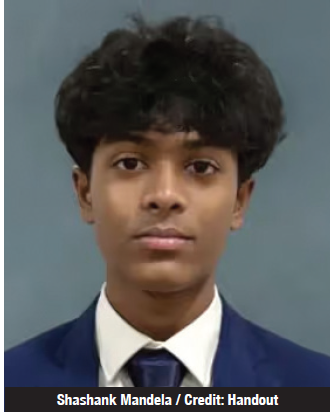
What started as a family moment in India turned into a global mission for 17-year-old Shashank Mandela, whose AI-powered app Kora is helping children with autism communicate and feel understood.
By Malvi ka Choudhary
NEW JERSEY — A simple family dinner in India changed the course of 17-year-old Shashank Mandela’s life. Watching his autistic cousin struggle to express his needs and emotions, the New Jersey teenager realized that technology could make a real difference. That moment of empathy sparked the idea for Kora — an AI-powered app designed to help children with autism communicate their emotions and connect with the right support.
A rising senior at Robbinsville High School, Mandela had always been close to his cousin. But during a visit to India before his freshman year, he saw firsthand the challenges his cousin faced, especially in expressing what he needed.
“That one visit to India was the turning point for me,” Mandela said. “I realized I could use my skills in technology to help him and others like him.”
From a Personal Idea to a Global Impact
What began as a solution for his cousin quickly grew into something much larger. Kora combines emotion recognition with interactive games to build emotional intelligence. The app also includes a parent forum, a helpful AI chatbot and a local resource directory that connects families with autism centers, volunteers and doctors.
Since its launch, Kora has reached more than 700 users worldwide and is now available in more than 25 autism centers across 12 countries. Mandela said the project has grown far beyond his original expectations.
“It started as a personal project, but it has become a global effort,” he said. “It’s been incredible to see how many families it’s helping.”
How the App Works
Kora’s emotion-recognition system uses a convolutional neural network (CNN) trained on more than 5,000 images of different emotions. The app provides a confidence threshold rather than treating an emotion prediction as a definitive answer, giving caregivers a better understanding of what a child may be feeling.
The app is primarily designed for children between the ages of five and ten. Its emotion-based activities aim to make communication more accessible while helping caregivers better understand children’s emotional needs.
Built on Purpose, Not Profit
Privacy and safety were key considerations in building Kora. The app does not collect images of children or use new users’ data to train the system. According to Mandela, user information is stored on the individual’s phone.
“Everything is stored on the user’s phone,” he said. “We don’t collect any images of children or anything like that because privacy is an important part of the app.”
For caregivers, the app includes an AI chatbot to answer everyday questions and a resource directory to find nearby centers, volunteers and doctors. Mandela said the chatbot was partly inspired by seeing his cousin’s family navigate limited access to reliable information and professional support.
He wanted families to have a more structured way to find guidance without having to travel long distances to reach a specialist.
A Team Effort and Growing Recognition
The project later became a team effort. Ayur Munapalli, Liam Casey and Joseph Pontoradio joined Mandela to refine Kora’s features and expand community involvement.
Their work earned the team a win in the Congressional App Challenge for their district and an invitation to the House of Code event in Washington, D.C.
“Meeting other students and seeing their innovative projects was truly inspiring,” Mandela said. “It gave me even more motivation to keep going.”
Beyond Kora: Education and Research
Mandela’s passion for AI and autism research did not stop with the app. He reached out to a professor at Yale University with a proposal for autism-related research and worked on a paper examining autism severity scores using machine learning. He said the paper is currently awaiting publication in a research journal.
He also founded Lumen AI, an organization focused on teaching students and teachers about artificial intelligence. Through workshops and student projects, the initiative encourages people to understand how AI works before using it.
“Many people think AI is either good or bad,” Mandela said. “The key is to understand how it works and use it responsibly.”
A Stronger, More Inclusive Future
Mandela’s experiences have shaped his views on inclusion and community. He believes people should not face discrimination because of autism or other differences.
“I don’t think anyone should be discriminated against because they are different,” he said. “Everyone deserves to be accepted.”
He credits his Indian heritage and the values instilled by his parents for encouraging him to focus on education, family and community service. Those principles continue to guide his work in technology and accessibility.
As he prepares for his senior year, Mandela plans to continue expanding his efforts in AI literacy and autism technology, with the goal of increasing Kora’s reach and impact.
“I feel strongly that technology can create a more inclusive and supportive world,” he said.
Keeping Kora Free
Despite Kora’s growth, Mandela said he has no plans to turn the app into a commercial venture. His priority is to keep it accessible to as many families as possible.
“I feel like the whole mission behind this was to keep it free and reach as many people as possible,” he said.
For Mandela, Kora represents more than a technological achievement. It is an example of how a personal experience, combined with curiosity and a desire to help others, can develop into a project with international reach.
Kora at a Glance
- Purpose: Helps children with autism communicate their emotions.
- Technology: AI-powered emotion recognition.
- Training: More than 5,000 images used to train its emotion-recognition system.
- Features: Interactive games, parent forum, AI chatbot and resource directory.
- Reach: More than 700 users worldwide.
- Availability: Used across more than 25 autism centers in 12 countries.
- Privacy: Designed with a focus on user privacy and on-device data storage.
- Mission: Keep the app free and make support more accessible to families.
Photo caption: Shashank Mandela, a New Jersey teen and creator of the Kora app, which helps children with autism communicate their emotions.
App illustration caption: Kora, the AI-powered app created by Shashank Mandela, helps children with autism express their emotions and access valuable resources.