








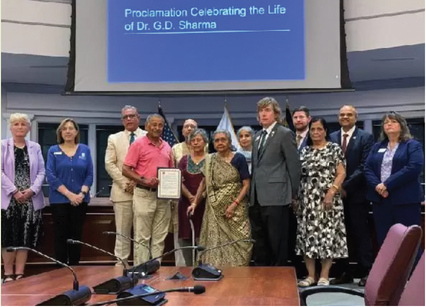
Raleigh, North Carolina: Members of the Indian-American community, elected representatives and public officials across North Carolina have paid tribute to Dr Ganga Dhar “G.D.” Sharma, a scientist, professor, community builder and spiritual leader who played a foundational role in establishing the Indian-American community in the Research Triangle region. Sharma, who died on July 31 at the age of 100, was remembered as a pioneering figure whose contributions extended far beyond his professional career. Over several decades, he helped build institutions that became important centres for religious, cultural and community life for thousands of Indian Americans across North Carolina. His life journey, marked by personal hardship, academic achievement and community service, was widely described by those who knew him as an example of perseverance, humility and dedication. Born near Agra in Uttar Pradesh, Sharma was orphaned at a young age. Despite facing significant challenges during his childhood, he pursued education and went on to establish a successful career as a scientist and university professor. He later immigrated to the United States via Canada in the 1970s. Following an assignment at the Research Triangle Institute, he settled in North Carolina with his wife, Saroj.
While building his professional career, Sharma devoted much of his personal life to serving the growing Indian-American community. He also spent nearly five decades volunteering as a Hindu priest, offering spiritual guidance and helping families maintain their religious traditions in a new country. For many members of the community, his contribution was not limited to religious service. He played a central role in creating institutions and networks that helped Indian immigrants establish a sense of belonging in North Carolina.
One of Sharma’s most enduring contributions came in 1976, when he and his wife, along with 20 other families, helped establish the Hindu Society of North Carolina (HSNC). At the time, the Indian-American population in the region was considerably smaller, and organised religious and cultural facilities were limited. Early gatherings were held in basements, homes and rented halls, where families came together for prayers, festivals and community events. Over the years, those modest gatherings developed into a major religious and cultural institution in Morrisville. The HSNC temple and cultural centre now serves thousands of people each week and has become an important hub for Hindu religious observances, cultural programmes, education and community activities. Community leaders said Sharma’s contribution was instrumental in laying the foundation for an institution that would continue to serve generations of Indian Americans. Sharma and his wife also founded the Hindi Vikas Mandal, an initiative aimed at promoting the Hindi language and Indian cultural heritage among younger generations. Through the organisation, hundreds of young people received opportunities to learn Hindi and connect with their linguistic and cultural roots. The couple also helped bring prominent Indian poets, writers and artists to North Carolina, giving members of the community an opportunity to experience Indian literature, music and performing arts. The initiative reflected Sharma’s belief that preserving cultural identity was an important part of building a strong immigrant community while also embracing life in the United States. Sharma’s decades of contribution to North Carolina and its communities earned him the Order of the Long Leaf Pine, one of the state’s highest civilian honours. The recognition reflected a lifetime of service that extended across science, education, religion and community development.
His supporters said his influence was particularly significant because he helped establish many of the institutions and traditions that later generations of Indian Americans would inherit. Paying tribute to Sharma, state Senator J. Chaudhury described him as the “father of the Triangle’s Indian American community.” “He didn’t just build a temple, he built a home for tens of thousands of us who came to North Carolina looking for one,” Chaudhury said. The remarks reflected the broader sentiment among community members who viewed Sharma not simply as a religious or cultural leader, but as one of the people who helped create a sense of community for Indian immigrants settling in the Research Triangle. His influence extended across generations, with many younger Indian Americans benefiting from institutions and cultural programmes that were established during his lifetime. Sharma’s daughter, Madhu Sharma, a Vedic scholar, said her father’s greatest legacy was the strength of the community he helped build. “From a childhood marked by loss to a life of science, faith, teaching and service, he transformed personal resilience into collective strength,” she said. Although Sharma died at the age of 100, she said the community he helped create would continue to reflect his values and carry his spirit forward. “He may have left this world at 100, but the community he helped create will continue to carry his spirit forward,” Madhu said. Dr Dhiren Thakkar, former dean of the School of Pharmacy at UNC Chapel Hill, remembered Sharma as an influential figure whose impact came not through power or prominence but through his character. Thakkar described Sharma’s influence as rooted in “the quiet power of kindness, empathy, humility and dignity.” He also called Sharma a true “servant leader” and said his contributions would be remembered by the community for generations. For those who worked with him or sought his guidance, Sharma’s willingness to serve others was one of his defining characteristics. Morrisville Mayor T.J. Cawley, who considered Sharma a friend, also paid tribute to the centenarian. Cawley had joined hundreds of admirers in celebrating Sharma’s 100th birthday and remembered him as a visionary who played a significant role in transforming Morrisville and contributing to the wider development of North Carolina’s Indian-American community. His work coincided with the growth of the Research Triangle and the increasing arrival of Indian professionals, families and entrepreneurs in the region. Indian-American political leader and Town Council member Satish Garimella recalled a particularly significant moment in his own public-service journey. Garimella said Sharma had the honour of administering his oath of office when he became the first Indian-born American elected in North Carolina. Reflecting on Sharma’s contribution to the community, Garimella said: “He set the sail — it is now our responsibility to carry that legacy forward.” The remark captured the sense of responsibility felt by many community leaders who see Sharma’s life as a foundation on which future generations can build. Sajjan Agarwal, chairman of the HSNC Temple, said Sharma began his community work at a time when Hindu religious and cultural infrastructure in the region was almost non-existent. “He planted a seed,” Agarwal said, describing how that early effort eventually developed into a major institution serving generations of Hindu families. “That seed has grown into a remarkable spiritual, religious, cultural and community institution serving generations of Hindus,” he added. The temple today serves not only as a place of worship but also as a venue for cultural celebrations, educational programmes, community gatherings and social activities. Sharma’s influence also reached beyond the Research Triangle.
Ishan, a former chair and current Executive Committee member of NCINPAC and an IBM executive, highlighted the role Sharma played in inspiring the growth of Hindu community initiatives elsewhere in North Carolina. He specifically pointed to the development of Hindu community and temple efforts in Greenville, saying Sharma’s example encouraged others to establish and strengthen cultural and religious institutions in their own communities.
His contribution therefore extended beyond the organisations he directly helped establish, influencing a wider network of Indian-American and Hindu community initiatives across the state.Harider Dhindsa, owner of Swagat Restaurant, remembered the Sharma family for their commitment to keeping Indian traditions, festivals and community gatherings alive.Through religious celebrations, cultural programmes and social events, Sharma and his family helped create opportunities for Indian Americans to maintain connections with their heritage while establishing roots in North Carolina. Community members said these traditions became especially important as the Indian-American population expanded and younger generations grew up in the United States. Sharma spent his final days surrounded by his family. He continued to recite prayers alongside his wife, Saroj, reflecting the faith and spiritual commitment that had been central to his life. From a difficult childhood near Agra to a century of achievement and service in North Carolina, Sharma’s life spanned science, education, religion and community building.His supporters say his greatest achievement was not any single institution or award, but the community he helped createone that gave generations of Indian Americans a place to worship, learn, celebrate their heritage and build connections. As tributes continue to pour in from across North Carolina, community leaders say Sharma’s legacy will live on through the institutions, cultural traditions and generations of families that benefited from his decades of service.